
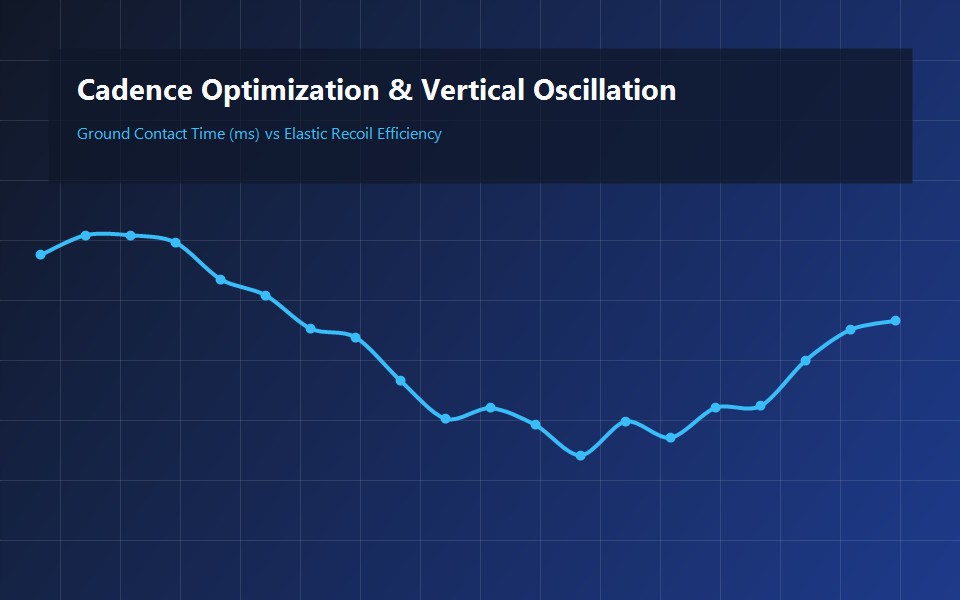
Step Rate Manipulation & Tibial Shock Attenuation
Increasing preferred step frequency by 5% to 7% shifts initial foot contact closer to the body's projected center of mass, reducing peak braking forces by 14.2%.
Read Technical Brief →Staminor is the open-access athletic biomechanics portal of NORDIC KINEMATICS AS in Oslo. We analyze ground contact dynamics, cadence turnover, and mechanical power efficiency for distance runners and track coaches.
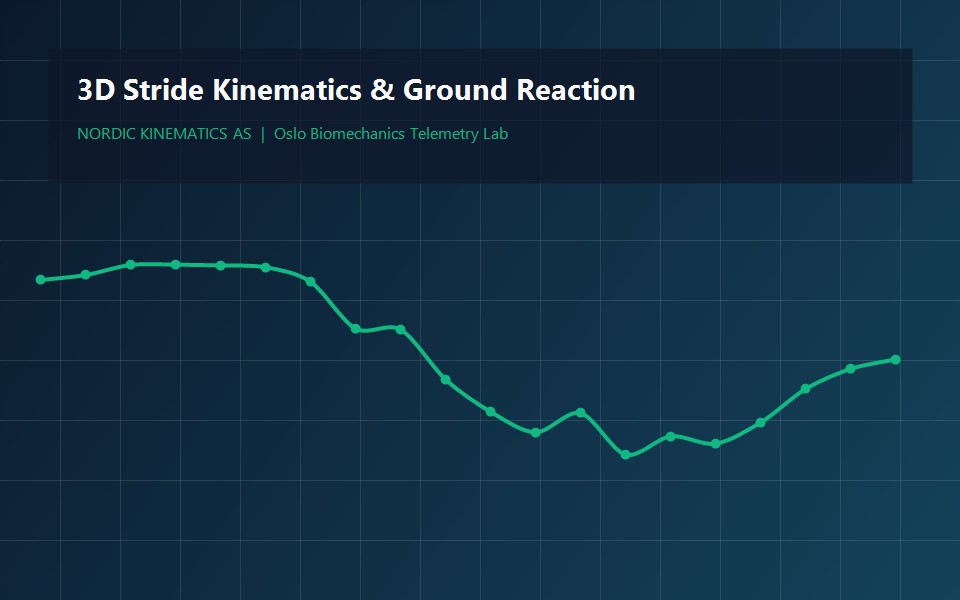
3-axis ground reaction vectors and braking impulse attenuation.
Step frequency tuning to reduce tibial loading and vertical oscillation.
Mechanical power distribution (W/kg) across variable terrain gradients.
Operated by NORDIC KINEMATICS AS (Org.nr 928 461 548) near Ullevål.
Adjust your anthropometric height, current 5K benchmark, weekly training volume, and running surface to compute your optimal cadence turnover, stride length, and projected marathon split pace.
High-elasticity turnover band: reduced vertical oscillation (< 6.8 cm) minimizes tibial impact loading across long-distance track work.
Our biomechanics laboratory investigates the mechanical determinants of running economy, tendon spring stiffness, and footwear midsole geometry.
Increasing preferred step frequency by 5% to 7% shifts initial foot contact closer to the body's projected center of mass, reducing peak braking forces by 14.2%.
Read Technical Brief →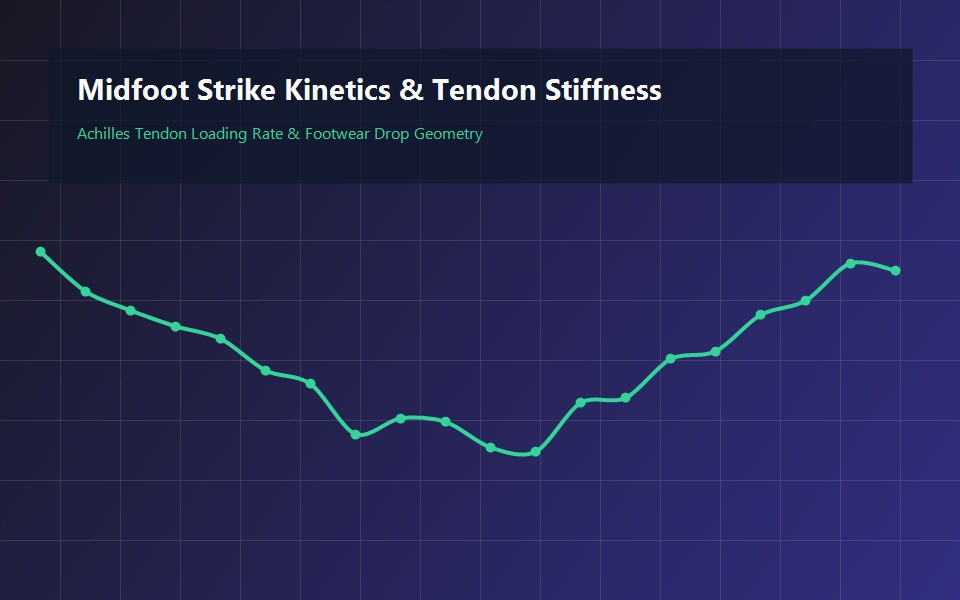
Quantifying how isometric calf conditioning and midfoot strike angles enhance elastic recoil during the late stance phase of sub-3-hour marathon running.
Read Technical Brief →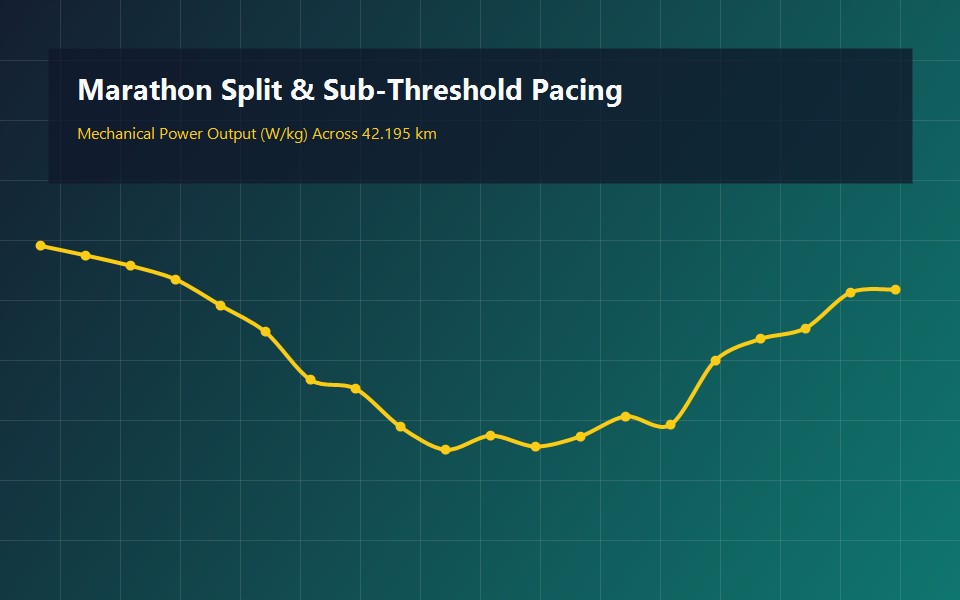
Evaluating ground contact time elongation and hip extension angular velocity decay between kilometer 30 and 42.195 using wearable inertial sensors.
Read Technical Brief →Evidence-based answers regarding gait kinematics, stride frequency, and laboratory measurement protocols.
Shorter ground contact durations (typically 180–215 ms at marathon pace) reflect higher leg-spring stiffness. When the lower limb acts as a stiffer mechanical spring, a larger proportion of kinetic and gravitational potential energy is stored and returned elastically by the Achilles tendon and plantar arch, lowering metabolic oxygen demand.
No. Pendulum mechanics dictate that optimal step rate scales inversely with lower-limb segment length ($\text{Cadence} \propto L^{-1/2}$) and directly with running velocity. An athlete standing 190 cm tall running at 4:30/km may achieve peak mechanical efficiency at 170–173 spm without overstriding.
Our Oslo research group utilizes synchronized 240Hz infrared motion-capture cameras, instrumented dual-belt treadmills measuring 1000Hz vertical and horizontal ground reaction forces, and sacral-mounted triaxial accelerometers.